Blog Archives
The Importance of Flexibility Training
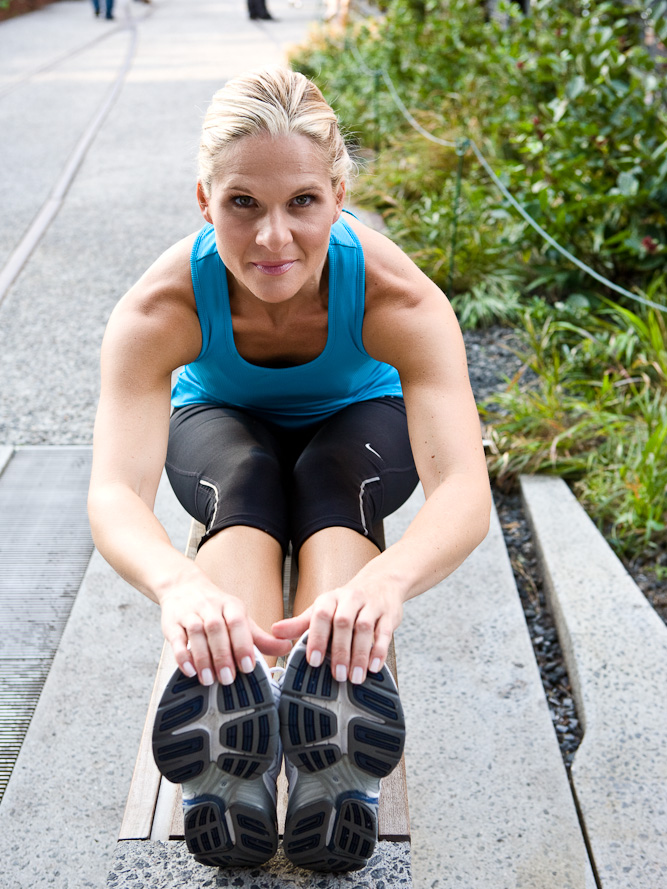
Photo by: Leslie Hassler
We made it to another Friday! If you’re like most people, you’ve clocked countless hours this week sitting at a desk crouched over a keyboard. Or maybe you’ve logged hours in your car commuting or taking the kids to and from school and activities. Regardless of your daily activities, chances are you suffer from an all-too common problem for modern day Americans: bad posture. This matched with an ever-increasing sedentary lifestyle for people everywhere make a recipe for disaster where your body is concerned. This is why incorporating flexibility training (a.k.a. stretching) is more important than ever. It is one of the best ways to decrease muscle imbalances, joint dysfunction and overuse injuries.
While I can’t assess how your body moves via this post, I can tell you about one of my biggest “problem areas.” When I’m not out in the field producing shoots, I spend way too much time sitting in front of my computer. Since I’m almost always on deadline, I tend to lose track of just how long I sit there. These extended periods of sitting unfortunately cause tightening of my hip flexors, which are made up of five muscles including the psoas.
What happens if I I don’t take the time to stretch my hip flexors and just get right into the “heart” of a workout? There are plenty of terms in exercise science to describe the problematic results, including altered reciprocal inhibition, synergistic dominance and arthrokinetic dysfunction. Here’s what those problems look like when it comes to performing one of the most popular exercises known to man: the squat. If I repeatedly perform squats with a tight psoas, the “wrong” muscles end up doing the work. The gluteus maximus should be the prime mover, but tight hips flexors inhibit the gluteus maximus from doing its job and getting strong. Instead, the workload gets picked up by the “B team:” the hamstrings and erector spinae. Not only does this make the butt-kicking exercise pretty much ineffective for actually toning my butt, but I’m also putting myself at risk for low back pain and potential injury.
Here’s a link featuring some good static stretches for the hip flexors. If you’re just getting started on an exercise program, your focus will most likely be on corrective flexibility in order to improve any muscle imbalances and altered joint motion. To that end, static stretches and self-myofascial release should be the key components in your flexibility training program. (Stay tuned for more on my own love-hate relationship with SMR in future posts!)
Another problem area for many people is the biceps femoris, which most of us know as the hamstrings. As you progress in your fitness journey, you can look forward to moving from corrective flexibility to active flexibility. In the video below, I help Brent Brookbush illustrate an effective active biceps femoris stretch. Before you check out the video, I leave you with this final thought: if I could go back in time and change one thing about my life-long love affair with fitness, I would incorporate much more flexibility training into my routine. It is truly one of the best things we can do for ourselves in order to have fun, be fit and feel fabulous!
The Importance of Balance Training
 Photo by: Leslie Hassler
Whether you’re walking down a staircase in stilettos or prepping to make a jump shot on the basketball court, balance is a key component to all functional movements. This is why balance training exercises should be a part of everyone’s fitness regimen, regardless of your fitness level.
Balance is the ability to sustain or return the body’s center of mass or line of gravity over its base of support. The National Academy of Sports Medicine (NASM) explains the purpose of balance training is to improve dynamic joint stabilization, which is the ability of the body to stabilize of keep the joints in proper alignment during movement. (One example: stabilization of the hip during a squat by the gluteus medius and adductor complex.)
Countless studies have been done which show a direct correlation between balance training and injury prevention. I think it’s safe to say we’d all agree anything that can help decrease our risk of injury is worth spending some time on.
So how do you do it? The idea is to perform exercises that constantly stress a person’s balance threshold. This is the limit a person can perform an exercise without losing control of his or her center of gravity. In “big-word terminology,” the idea is to push that threshold in a proprioceptively enriched environment. This is an environment that challenges the internal balance and stabilization mechanisms of the body.
In simple terms, balance training is typically performed on a single-leg and/or on unstable surfaces such as a half-foam roll, Airex pad or Dyna disc. For beginners, examples of balance training exercises include single-leg balance and single-leg balance reach. More “seasoned” fitness buffs may perform single-leg squats or single-leg Romanian deadlifts. Finally, balance training exercises for the experienced athlete may include multiplanar hop with stabilization or single-leg box hop-ups with stabilization.
I found this link very helpful in describing the purpose for balance training along with this one from the Mayo Clinic featuring examples of exercises. At the end of the day, balance training can be a challenging part of your exercise program and just one more way to have fun, be fit and feel fabulous!
The Importance of Core Training
 Photo by: Leslie Hassler
Chances are you’ve heard, seen or read stories about people’s quest to work on their “core.” That’s good, because core training should be a crucial component of anyone’s exercise routine, regardless of his or her fitness level. Why? To put it simply, if you have a weak and unstable core and you don’t do anything to make it stronger, your body can’t move the way it’s supposed to. That’s one of the easiest ways to put yourself at increased risk for injury.
So, what exactly is the core? It’s the part of the body made up of the lumbo-pelvic-hip-complex, thoracic spine and cervical spine. This region of the body is where all movement begins and where we find our center of gravity. The muscles in the core are broken into two categories: the stabilization system and the movement system. The important thing to keep in mind is that if the stabilization system doesn’t work properly, then your body will make compensations to move, and these compensations can ultimately lead to injury. Here’s an example: you could have strong “abs” (rectus abdominus), external obliques and erector spinae, but weak stabilizing muscles in your lumbo-pelvic-hip complex. Without proper stabilization, extra stress is placed on your vertebrae and this can lead to low back pain and possible injury.
The bottom line is you should not neglect your core. One popular exercise for core training is the quadruped. It’s a great activation exercise for the transversus abdominus, which is part of the stabilization system of the core. Below, you can check out a video where I help Brent Brookbush, President of B2C Fitness and author of “Fitness or Fiction: The Truth About Diet and Exercise,” illustrate the correct form and progression techniques for a quadruped. Brent’s videos are geared toward other fitness pros, but the information and illustration are a great way to get anyone started on this effective exercise. Remember, core training is an essential part of any exercise routine in order to have fun, be fit and feel fabulous!


 lauralovesfitness