Blog Archives
Balance is Key!
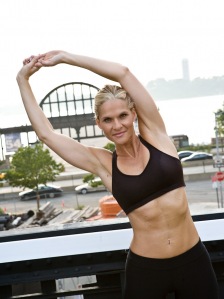
Photo by Leslie Hassler
I often write about the importance of incorporating flexibility and core training into your fitness routine. Now as we kick off the month of August with a Workout Wednesday, I wanted to touch on what should be another important component in everyone’s fitness regimen regardless of your fitness level: balance training.
Balance is the ability to sustain or return the body’s center of mass or line of gravity over its base of support. Basically, that means whether you’re walking down a staircase in stilettos or setting up to make a jump shot on the basketball court, balance is a key component to all functional movements.
From an anatomical perspective, The National Academy of Sports Medicine (NASM) explains the purpose of balance training is to improve dynamic joint stabilization, which is the ability of the body to stabilize of keep the joints in proper alignment during movement. (One example: stabilization of the hip during a squat by the gluteus medius and adductor complex.)
Maintaining proper alignment or form while working out is one of the ways to protect yourself against exercise-related injuries. In fact, countless studies have been done which show a direct correlation between balance training and injury prevention. I’d like to think we all agree anything that can help decrease our risk of injury is worth spending some time on.
So how do you do it? The idea is to perform exercises that constantly stress a person’s balance threshold. This is the limit a person can perform an exercise without losing control of his or her center of gravity. In “big-word terminology,” the idea is to push that threshold in a proprioceptively enriched environment. This is an environment that challenges the internal balance and stabilization mechanisms of the body.

Photo by Lauren Bachner
In simple terms, balance training is typically performed on a single-leg and/or on unstable surfaces such as a half-foam roll, Airex pad or Dyna disc. Some examples:
- For beginners: Single-leg balance and single-leg balance reach.
- More “seasoned” fitness buffs: single-leg squats or single-leg Romanian deadlifts.
- Top of your game: multiplanar hop with stabilization or single-leg box hop-ups with stabilization.
One of my all-time favorite balance exercises is a single-leg bicep curl. It not offers proprioceptive challenge, but you can feel your core engaging to keep your body stable while working the arms. (Make sure to switch legs between sets.) As always, if you have a favorite balance training exercise, I’d love to hear about it!
I found this link very helpful in describing the purpose for balance training along with this one from the Mayo Clinic featuring examples of exercises. At the end of the day, balance training can be a challenging part of your exercise program and just one more way to have fun, be fit and feel fabulous!
A Fitness-Filled Weekend
It’s probably safe to say most of us wonder where our weekends go. This one, however, flew by particularly fast for me as it was one filled with plenty of fitness fun – both physical and mental.

With B2C President Brent Brookbush & “Classmates” the “Intro to Functional Anatomy” Workshop
Mother Nature graced us with one of the most magnificent weekends in recent memory filled here in New York City. Since I wanted to get out and enjoy the sunshine as early as possible on Saturday, I got my butt to the gym before 9 am and put my new love of Tabata training to good use. If you’re looking to make the most of an hour at the gym, here’s what I got accomplished in that time Saturday morning:
- 5 minute self-myofascial release (SMR) with the foam roller and static stretches for my calves, TFL and latissimus dorsi.
- 20-minute”Tabata Derby”: Using my UltraTimerHD app (as recommended by my friend and fitness pro Roberto Murichi), I completed four sets of Tabatas featuring the following exercises: squats, push-ups, sit-ups and planks. Thanks to the app, I simply pressed start and knew exactly when to work for 20 seconds, rest for 10 and continue. Once the first four-minute Tabata was completed, the app also allowed for the crucial 60-second “rest” period before moving on to the next exercise.
- 1000-meter rowing “sprint.” This took me about 10 minutes. Not my best time ever, but I had just finished the Tabata Derby, so I gave myself a bit of a break.
- 20-minute interval elliptical training. (The last five minutes were more of a cardio cool down.)
- 5 minutes SMR and stretching, mirroring what I did at the start of the workout.
Sunday’s “workout” lasted much longer – a little more than eight hours to be exact – but it was a totally different experience. I spent the day at the Sports Club/LA on New York’s Upper East Side for a B2C Fitness workshop entitled “Functional Anatomy 1: Intro to Human Movement Science.” The class was taught by my friend and B2C President Brent Brookbush.
Not only did taking the workshop help me gather some of the needed CEC’s (Continued Education Credits) I need to maintain my personal training certification with the National Academy of Sports Medicine, but it also offered an amazing refresher on anatomical terminology and the interactive function of joints, muscles, fascia and the nervous system as it relates to human movement.
 The course was filled with fun anecdotes and interactive activities, and it was also great to meet other personal trainers and fitness professionals with different levels of experience in the industry. Any of my readers who happen to be fellow fitness pros and need some CEC’s (or just want to brush-up on everything from planes of motion to movement analysis), I’d recommend taking any of Brent’s workshops in a heartbeat.
While the physical and mental workouts may make for a groggier Monday than usual, I’m happy to be armed with refreshed energy and knowledge to continue on the quest to have fun, be fit and feel fabulous!
Why Laura Loves the Foam Roller
Welcome to yet another Workout Wednesday!
The last few weeks, I’ve been focusing on some pretty intense exercises that get my heart racing courtesy of my small group training class. For today, I decided to shift gears to address what should be a key component in everyone’s exercise regimen regardless of his or her fitness level: flexibility training. Click here for a reminder on why we all need to make more time to incorporate stretching into our daily routines.
Every stage of flexibility training – corrective, active or functional – incorporates one common denominator: self-myofascial release, or SMR. My NASM textbook defines this stretching technique as one that focuses on the neural system and fascial system in the body. Here’s a video where I demonstrate how SMR works on one of the most common problem areas – those aching calves!
Many thanks to director/producer Larry Saperstein and the crew at C & C Studios for their help with this production and to editor extraordinaire Rob Romas for putting it together. (Check out Rob’s new business Sports Media Recruit which provides video resumes for student athletes.)
I’ve said it before, and I’ll say it again: if I could go back in time and change one thing about my life-long love affair with fitness, it would be to incorporate much more flexibility training into my routine. It’s truly one of the best things we can do for ourselves in order to have fun, be fit and feel fabulous!
50-30-20…Drop!

My classmate was amazed I could still smile after the killer workout!
We made it to another Workout Wednesday!
I have no idea where the last four weeks went, but tonight actually marks my last Ultimate Fitness Experience small group training class at New York Sports Club. It’s been a challenging month, as my friend and fellow NASM certified personal trainer Roberto Murichi made sure each and every workout was a true butt-kicking experience.
What I’m about to share with you is not a workout I’d recommend for a fitness newbie or anyone returning to an exercise routine after a hiatus. However, for anyone looking to kick things up a notch – here’s the workout I sweat through on Monday night.
Our warm up consisted of 16 rounds of kettlebell lunges and kettlebell swings. We performed as many reps as possible in 20 seconds, followed by 10 seconds of rest. We’d switch exercises every two rounds. With our heart rates up, it was time to get to the heart of the workout: the 50-30-20. The idea is simple. The execution, however, is a different story.
Roberto chose four “basic” exercises for us to perform in the following order: push-ups, squats, sit-ups and squat thrusts. (A squat thrust is basically a burpee without the jump at the end.) For round one, we had to perform 50 reps of each exercise. In round two the reps dropped to 30 and finally for the third and final round, we ended with the “easy” task of 20 reps per exercise. So yes, that meant 50 push-ups followed by 50 squats, 50 sit-ups and 50 squat thrusts. At the end of the workout, we’d completed 100 reps of every exercise. Of course, we were allowed to rest whenever we needed to catch our breath or get some water. It took me just under 23 minutes to complete the workout, and kudos to one of my classmates who nailed it in about 18.

The breakdown
Again, the 50-30-20 isn’t for everyone, and it’s crucial to make sure you add some flexibility training before and after this kind of routine to take care of your muscles. One logistical benefit of this workout is that you don’t need a gym to make it happen. Aside from needing kettlebells for the warm up, the heart of the workout includes exericses that can be done at home or at the park.
I can’t wait to find out what Roberto has in store for us tonight in our last UFX session. I’m glad I took the class, as I learned some new techniques and definitely pushed my body to new levels. Even those of us who thrive on working out can get caught in a rut sometimes, and this class kicked me right out of it! That’s one of the things I truly love about exercise – there’s always something new you can do to to have fun, be fit and feel fabulous!
Birthday Reflections
What a difference a year makes!
 As the celebration of my 38th birthday winds down, I can’t help but sit here and think about the plans I made on this very same date last year.
It was February 9th, 2011 when I made the phone call to reserve my spot for the National Academy of Sports Medicine‘s certified personal trainer exam. I started studying immediately following a weekend of birthday fun. Three months later – May 21st, 2011 to be exact – I passed the exam. These days when I’m not busy with my full-time production job or writing posts for this blog, I brush up on my studies to create exercise programs for my personal training clients.
While I’ve thought about becoming a personal trainer since finishing my days at Northwestern University, there’s a whole other aspect of fitness I never expected to fall in love with in my 30’s. As a lifetime lover of dance and exercise, I’m not sure why I didn’t give Zumba Fitness® a try until November of 2011, but I guess that old expression really is true: better late than never. It only took one demo class to get me hooked, and a just last month, I became a licensed Zumba instructor. Now, I’m trying to figure out how to fit some practice and choreography time into my schedule along with my full-time job, personal training, blogging and the rest of life’s everyday hustle and bustle so I can actually start teaching Zumba in the spring.
For me, this is just the latest move in the you-can’t-plan-everything-in-your-life playbook. Even when you set a course, make a plan and list your goals – something may come along to throw things off course. And that something can be the best thing you never planned for.

Some birthday love at work
I’m excited about the start of a new year in my life. Like everyone else, there are trials and tribulations I’ve dealt with this past year that I’m happy to leave in the past. There are other challenges I’m struggling with today and will continue to grapple with tomorrow. But just like in years past, exercise will remain one of the few constants that can help keep my head on straight even on my most stressful days and lowest times.
So, I end this work week another year older. I’m not sure if that makes me another year wiser, but I am looking forward to discovering what lies ahead in the next 365 days and all the new opportunities to have fun, be fit and feel fabulous!
Here’s to Another Workout Wednesday!
Happy Workout Wednesday!

Photo by Leslie Hassler
This week I offer some new exercises for your stabilization endurance routine. There’s something important to note about this level of training: it’s not just for workout newbies and those returning to exercise after a hiatus.
NASM teaches it’s also crucial for exercise veterans to re-visit the stabilization level after periods of strength or power training. Why? Because performing exercises that challenge the body’s proprioception is a surefire way to maintain your core and joint stability. I don’t care how much weight you can push with your chest muscles on a bench or curl at a seated machine with your biceps. After intense strength or power training, keeping your body in a bridge while performing a couple of sets of ball dumbbell chest presses offers a good reminder of how important it is to maintain your core strength!
Don’t forget to warm-up before jumping into this routine and cool-down when you’re done. For each exercise, aim for two sets of 12-15 reps.
Core:
Resistance:
- Total body: Step up balance to overhead press
- Chest: Push ups
- Back: Ball cobra (2-arm)
- Shoulders: Single-leg dumbbell scaption (alternating arm)
- Biceps: Single-leg bicep curl
- Triceps: Supine ball dumbbell triceps extension
- Legs: Body weight squats
I don’t mean to sound like a broken record, but you need to visit and re-visit this training level throughout your year-round workout cycle to keep your muscles the way they’re supposed to. If you’re a “regular” here at LauraLovesFitness.com, you may know the following chain reaction by heart: when your muscles don’t work properly, your body makes compensations to keep moving. Those compensations eventually lead to muscle imbalances which lead to increased stress on the joints which can ultimately lead to injury.
As with the other workouts I’ve presented, your goal should to perform today’s program two to three days each week, but don’t perform the same routine on back-to-back days. Your muscles need time to recover and repair, which is accomplished through rest. So you could perform this program on Tuesdays and Thursdays and get your cardio on the in-between days. Whatever you do, never skimp on the stretching!
So, what are some of your favorite stabilization exercises? You know I’m always looking for new ideas to help all of us on our quest to have fun, be fit and feel fabulous!
The Lunchtime Workout
 I’m not sure where the weekend went, but here we are facing another Monday and the last two days of January! As my type A+ personality starts mentally preparing for a pretty intense work week, I thought I’d address a fitness-related question that has a work angle, too.
Aimee recently posed the following question via my LauraLovesFitness Facebook page: Any advice for those of us fitting in 30 minute lunch workouts? I am typically doing 20-25 minutes of cardio followed by a quick core/weights. If you could recommend treadmill/arc trainer settings to get the most of it plus times – I would appreciate it!!!
First of all, kudos to Aimee and anyone else who uses a lunch break for the benefit or his or her health! Regardless of what time of day you working out, I recommend getting a heart rate monitor as it takes the guess-work out of determining just how hard your body is working. (Those silver heart-rate measuring “strips” on the cardio machines aren’t always accurate.)
Now as far as the workout goes, here’s the bottom line: it doesn’t matter what the incline or resistance settings on the machine say. What does matter is whether you’re working at a challenging yet safe level within the appropriate heart rate zone for your stage of training.
For the purpose of this post, I’ll offer some parameters for anyone working out with a goal of body fat reduction. The Law of Thermodynamics teaches us that to reach this goal, you must burn more calories than you consume. Cardio is usually one of the first things people start doing to make those calories disappear.
If you’re a beginner or returning to the gym after a hiatus, you should be performing cardio within heart rate zone one. Click here for a refresher on how to calculate your target heart rate for this zone. (My zone one heart rate is 119-137.) NASM principles indicate a person shouldn’t advance to zone two until he or she can maintain a zone one heart rate for at least 30 minutes two to three times per week.
One you’ve built a good base (which can take more than a month), you’re ready for zone two, which is 80-85% of your maximum heart rate (HR max). Again, I’ll use myself as an example for the parameters:
- 220-37 = 183 (HR max)
- 183 X 0.80 = 146
- 183 X 0.85 = 156
- Laura’s Zone Two Heart Rate = 146-156
This level is extra fun because if you’re working in stage two of your overall fitness program, this is where interval training comes in. For those using treadmills, arc trainers or other cardio machines, you can now increase the workload (speed, incline, level) to alter your heart rate between zones one and two. So here’s how my interval training would look on the elliptical:
- Five-minute warm up zone one (119-137)
- One minute in zone two (146-156)
- Five minutes in zone one
- One minute in zone two
- Five minutes in zone one
- One minute in zone two
- Three – five minute cool down in zone one
If Aimee’s ready for this stage of training, this would be a good approximate 20-minute cardio workout for the treadmill or arc trainer. Again, the key is to find a way to accurately measure her heart rate to make sure she’s working within the designated zones.
A couple of final notes: there is a heart rate zone three as well as a training stage three, but these are designated for advanced athletes. (I’d be happy to address these in a future post if anyone would like the information.) Finally, for Aimee or anyone who’s squeezing in some cardio, core and resistance training in a short period of time, please don’t skimp on the stretching! I know it’s tough to get it all in, but sticking with a well-rounded routine is one of the best ways to stay on track with your plans to have fun, be fit and feel fabulous!
Workout Wednesday: Another Stabilization Endurance Routine
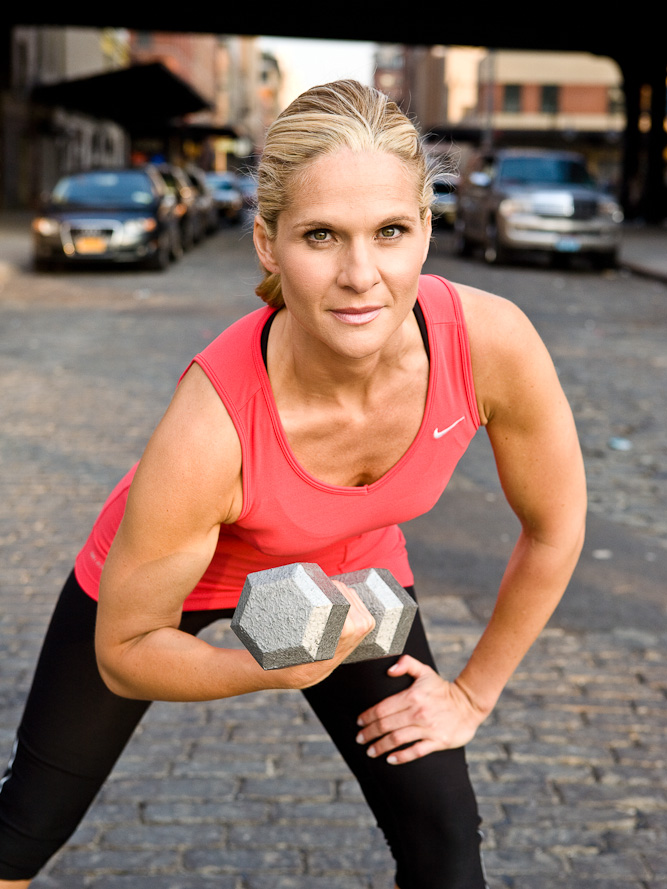
Stabilization Before Strength! Photo by Leslie Hassler
Happy Workout Wednesday!
As I received some positive feedback on the total-body workout I posted last week, I thought I’d post another one. Just like last Wednesday’s plan, these exercises provide a total-body resistance training workout for what NASM calls the stabilization endurance phase of training. If you’re new to the gym or returning after a break, this is the type of plan you should follow.
Don’t forget to warm-up before jumping into this routine and cool-down when you’re done. For each exercise, aim for two sets of 12 reps. (If you’ve never worked out before or starting again after a very long break, one set is just fine.)
Core:
- Single leg balance reach (**2 sets of 8 reps for each leg**)
- Total body: Ball squat to curl to overhead press
- Chest: Ball dumbbell chest press
- Back: Ball dumbbell row (2-arm)
- Shoulders: Ball military press
- Biceps: Single-leg bicep curl
- Triceps: Prone ball dumbbell triceps extensions
- Legs: Step-up to balance
I cannot stress enough the importance of the stabilization training phase being the correct starting point for an exercise regimen. Without stabilization, your muscles don’t work the way they’re supposed to and your body will make compensations to keep you moving. Those compensations lead to muscle imbalances which lead to increased stress on the joints which in the end can eventually lead to injury.
Aim to perform this program two to three days each week, but remember not to perform the same routine on back-to-back days. Your muscles need time to recover and repair, which is accomplished through rest. So perhaps you perform this program on Mondays and Wednesdays and get your cardio in on the in-between days. Whatever you do, make sure you don’t skimp on the stretching! I will be eager to hear more feedback on whether or not this program helps you on your journey to have fun, be fit and feel fabulous!
A Workout Wednesday Plan

Stabilization Before Strength Photo by Leslie Hassler
I get lots of questions from lots of people about what exercises are good for someone who is new to the gym or returning after a hiatus. So, in honor of “Workout Wednesday,” I thought I’d offer one of the programs I designed for my training sessions this past weekend.
The following exercises provide a total-body program for what NASM calls the stabilization endurance phase of training. It’s important to note you should perform an adequate warm-up before jumping into this routine and a cool-down when you’re done. For each exercise, aim for two sets of 12 reps. (If you’ve never worked out before or starting again after a very long break, one set is just fine.)
Core:
- Single leg balance (**2 sets of 8 reps for each leg**)
- Total body: Ball squat to curl to overhead press
- Chest: Ball dumbbell chest press
- Back: Standing cable row
- Shoulders: Single-leg scaption
- Biceps: Single-leg bicep curl
- Triceps: Prone ball dumbbell triceps extensions
- Legs: Step-up to balance
As I’ve written about in the past, the stabilization training phase should be the starting point for anyone new or returning to a fitness routine. Research has shown jumping into strength or power training before stabilization is a surefire way to increase your risk of injury. Simply put, without stabilization, your muscles don’t work the way they’re supposed to and your body being the amazing machine it is will make compensations to keep you moving. Those compensations lead to muscle imbalances which lead to increased stress on the joints which in the end leads to injury.
Aim to perform this program two to three days each week, but remember not to perform the same routine on back-to-back days. Your muscles need time to recover and repair, which is accomplished through rest. So maybe you go through this program on Mondays and Wednesdays. You can do cardio on the same day or on the in-between days and make sure you don’t skimp on the stretching! I will be eager to hear your feedback on whether or not this program helps you on your journey to have fun, be fit and feel fabulous!
Personal Training 101
Happy MLK, Jr. Day! I hope you’re enjoying the first long weekend of 2012.
I’m feeling extremely lucky to have kicked off the New Year enjoying back-to-back productive and life-changing weekends. Last weekend was all about becoming licensed Zumba® instructor. This weekend, I kicked my personal training goals into high gear.
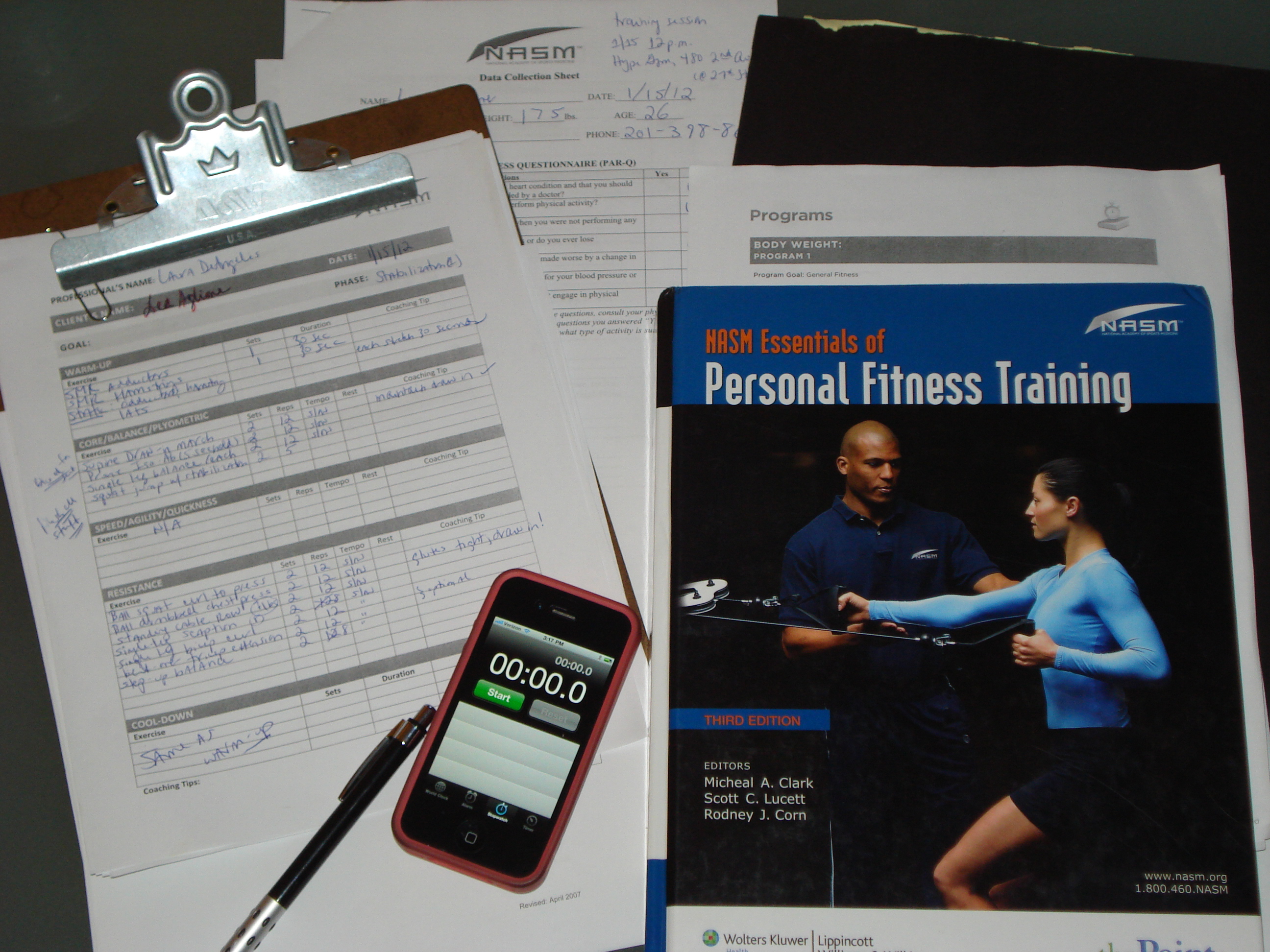
Prep materials & paperwork for training sessions
While I’ve written about guiding my friend Jared along his journey with a first-time gym membership, this weekend I conducted my first official personal training sessions at Hype gym here in New York City. I’m grateful to my colleagues Rebecca, Colleen, Lea and Lauren for signing up for these first workouts, and I’m already looking forward to the next round!
Each of these women came to me with a similar goal of reducing body fat and increasing the appearance of muscle definition, but each had her own unique background based on several factors including medical history and daily activities (e.g. wearing heels or sitting for a good part of the day because of her occupation). This is why it’s crucial to understand why a “one-size-fits-all” approach to exercise isn’t the best course of action. Just because your best friend has gotten great results from taking a certain group exercise class or running through a specific high intensity circuit on the weight floor doesn’t mean the same routine will work for you – especially if you’re body isn’t properly prepared for that type of workout.
This is where a personal trainer can help. Along with collecting subjective information about your general and medical history, we analyze crucial objective information (measurable data), as well. This includes performance assessments, one of most important being the overhead squat assessment. As I learned through my NASM instruction, this dynamic postural assessment is key in creating a safe and effective exercise program. Observing a person’s feet, knees, lumbo- pelvic-hip complex and shoulder complex while he or she performs an overhead squat shows which overactive muscles need to be stretched and which underactive muscles need to be strengthened. For example, a couple of the women had knees that turned out when performing their overhead squats. That meant we had to stretch the adductors (inner thighs), bicep femoris (hamstring) and tensor fasciae latae (TFL) as part of a warm up before jumping into the rest of the workout.
As far as the workouts are concerned, each woman has begun the first phase of her training: stabilization endurance. This includes lots of fun exercises like dumbbell chest presses and shoulder presses on a stability ball as well as bicep curls standing on one leg instead of two. These exercises have an added bonus: since the body needs to work harder to stay stable, you can end up burning a lot of calories. Each woman will remain in this phase of training for the next four weeks.
In the weeks ahead, I’ll keep you posted on their progress (here’s hoping they come back for lots of sessions!) and also share some specific exercise programs that will hopefully help you with your routine so you can have fun, be fit and feel fabulous!


 lauralovesfitness