A Healthy Happy Hour?
 For lots of people, Friday is the perfect excuse to head out of the office or leave the kids with a sitter and proceed directly to happy hour. Anyone who knows me will tell you I like my red wine, and enjoying a glass or two on a Friday evening is one of my favorite ways to wind down after the work week. If you don’t drink alcohol, your Friday night plans may still involve some good conversation and “decadent” snacks with friends. Regardless of what’s on your agenda, the good news is you can enjoy a little downtime without completely blowing your efforts at living a healthier lifestyle.
I’ve already written about my l0-cal cocktail options for some popular beverages. Here are a couple of other tips that help me balance my efforts to lead a healthy lifestyle with my need to blow off some steam and unwind:
- The Every-Other-Drink Rule: If you think you may want more than one drink, space them out. Start with a glass of wine or a cocktail, and when your glass is empty, order a glass of water, seltzer or diet soda for your next beverage. You’ll still feel “social” sipping on something, but by the time you’re done with that non-alcoholic drink, happy hour could be over and you’ll have saved yourself some calories and lots of sugar, too! (If you do order another “leaded” drink, it’ll only be your second alcoholic beverage instead of your third.)
- Happy Hour & Hunger Don’t Mix: There’s nothing worse than arriving at a bar or a friend’s house with a stomach that’s growling for anything. That’s when you inhale half a bowl of chips or order the loaded potato skins without a second thought. If you can, have a healthy snack within an hour before you go out so you’ll be less likely to indulge in the high-calorie, high-fat snacks. Some of my favorite pre-happy-hour snacks include: 94% fat-free microwave popcorn and an apple; a low-fat string cheese and an apple; or a serving of raw almonds and a plain fat-free Greek yogurt. If I’m not ravenous, I may be able to enjoy one drink and one glass of water and hold off on eating altogether until I have healthier options back at home. If I’m having too much fun to leave, at least hunger won’t keep me from noticing some of the better menu options, like a salad or steamed veggies.
Stabilization Before Strength
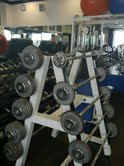 My friend Jared Morrison recently signed up for a membership at New York Sports Club. This being his first gym membership ever, we decided to turn it into a win-win situation for the both of us. Not only is Jared on his way to improving his overall health by getting on a regular workout schedule, but I am putting my NASM personal training studies into practice by helping Jared reach his goals. After meeting up with Jared for an assessment and kicking off a program, I was reminded of just how important the first phase of training is for anyone new to the gym or coming back after a hiatus.
The National Academy of Sports Medicine’s system for integrated training is called the OPT model, which stands for Optimum Performance Training. It is divided into stages and designed to help someone progress toward his or her individual goals in a safe and effective manner. The model is divided into three “building blocks:”
- Stabilization
- Strength
- Power
The bottom line is you should not focus on strength and power before you’ve tackled stabilization. Training in the stabilization phase allows you to increase muscular endurance and establish optimal communication between the nervous system and muscular system. Multiple studies have shown inefficient stabilization can cause muscles to produce force incorrectly and increase stress on the joints. This is a surefire way to put yourself at risk for injury.
Basically, the key exercises in this training phase are performed in a proprioceptively enriched environment, which is a “fancy” way of saying controlled, but unstable. These exercises challenge the body’s balance and stabilization systems. Many times, they involve taking a “traditional” exercise off a flat surface and moving you to an unstable one, like a stability ball; or standing on one leg instead of two. These exercises have an added bonus: since the body needs to work harder to stay stable, you can end up burning a lot of calories.
Here are some classic examples of stabilization exercises for resistance training. Aim to perform two sets of 12-20 reps of each:
- Total Body: Ball Squat, Curl to Press
- Chest: Ball Dumbbell Chest Press
- Back: Ball Dumbbell Row
- Shoulders: Seated Stability Ball Military Press
- Legs: Step-Up to Balance
In addition to his resistance training, Jared’s cardio routine will be working on reaching his goal of maintaining a zone one heart rate for a minimum of 30 minutes two to three times a week. (How to calculate your zone one heart rate.) He also will work on his core. Finally, as for flexibility training: he has the green light to stretch every single day – and multiple times a day if he can!
I am looking forward to monitoring and sharing Jared’s progress. In the meantime, I hope you’ve learned about some key stabilization exercises that can help your body perform at its best so you can have fun, be fit and feel fabulous!
Confused About Muscle Confusion?
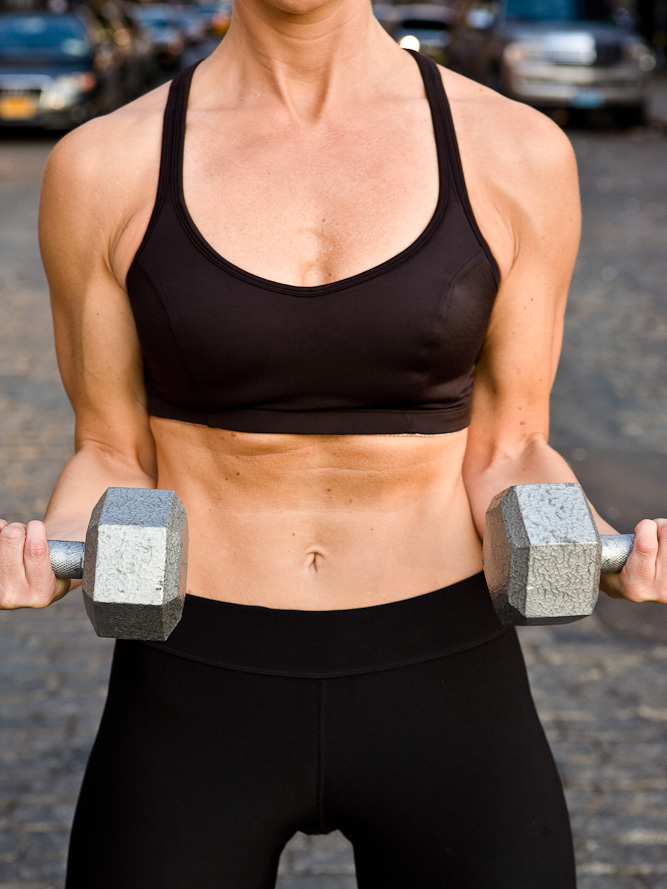
Photo by Leslie Hassler
I kick off this new work week addressing a great question from Ally. She asked about “muscle confusion,” a key concept in the workouts you see all over TV that promise to get you “ripped” in 90 days without going to the gym.
First, I have to admit due to space limitations in all the apartments I’ve lived in since getting out of college, I’ve always worked out at the gym. So, I’ve never bought or used any of these 90-day surpreme workout programs. However, I do know many people who use them and love them.
Second, from an exercise science perspective, muscles can’t technically get “confused.” What they can do is grow stronger through a process called volume overload. Another phrase you often hear when people describe their fitness goals is a desire to “tone up.” Again, this is technically an incorrect statement as sticking with an exercise program won’t “tone” muscle, but it can help you improve your overall muscle definition. Basically, whether you’re working out at the gym or in front of the TV, if you increase the workload placed on your body, you burn more calories than you store, which leads to a loss in body fat and an improvement in muscular definiton.
Ally also asked me how often I change my resistance training routine. What I learned through the National Academy of Sports Medicine is that whatever phase of training you’re in, you should stick with a current routine for a minimum of four weeks before moving on to the next level. This gives your body time to adapt to the stimuli you’re placing on it. That doesn’t just mean changing the exercises you’re doing, but adding to the workload you’re demanding your body to perform. When it comes to resistance training, that workload increase comes in the form of reps x sets x weight.
Remember, change doesn’t have to be drastic. It can simply involve cutting back on the amount of rest between exercises to push caloric burn to the max. Change can also involve filling your schedule with group boxing class on Monday, group body conditioning on Wednesday and a solo weight machine circuit on Friday. Want another reason to mix up your routine? It’s simple: too much of a good thing is never good. Doing the same exercises every day is a surefire way to increase your risk of overuse injuries. Which brings me to another important reminder: your body needs adequate rest to make adequate gains. So, be sure not to work the same muscle groups on consecutive days.
I want to wrap up with what could be most important: in a world filled with instant everything, you need to be patient when it comes to reaching your diet and exercise goals. Anything done in an extreme fashion may produce fast results, but these results are often unsustainable. Drastically restricting your calorie intake and working out for 90 minutes, seven days a week may get you into that dress for the reunion. Chances are once you go back to your normal lifestyle, the weight will come back and any gains you made will be lost.
In the end, the choice is yours. Whether you try a 90-day DVD exercise program, join a gym or start taking tennis lessons with a friend, the key is to find what works for you so that you stick with it and don’t stray from the path to have fun, be fit and feel fabulous!
More Music That Moves Me
 I am always listening for new music to add to my “workout mix” playlist. Thanks to my friend Gabby, I discovered the Kim Sozzi Radio “station” on Pandora and I’ve collected some good beats to move to while working through a heart-pumping cardio or circuit training workout. What I particularly like about these songs is that you won’t hear them on mainstream radio a dozen times a day. In fact, chances you are you may not hear some of them even once today on a local radio station. So, as we head into another weekend, here are my 10 new favorites that keep me moving at the gym. (They also help me keep walking at a pretty good pace during my walk to work in the morning!)
“Get Better” KMC featuring Sandy
“Why You Had to Leave” Cascada
“Point of No Return” Unique/DJ Encore
“Chemistry” (Eric S Remix Radio Mix) Velvet
“The Longest Road” (Deadmau 5 Mix) Morgan Page
“I Can’t Help Myself” (Sunfreakz Mix) Bellatrax featuring Sophia May
“Flatline” (Kyau & Albert Radio Edit) Cosmic Gate featuring Kyler England
“Can’t Sleep” Above & Beyond
“Man on the Run” Cerf, Mitiska & Jaren
“Unforgivable” Armin van Buren featuring Jaren
I realize there are a lot of music genres out there, and these dance songs may not motivate you to move. That being said, I’d love to hear what tunes keep you in motion! Also, if you have music that helps you cool down, stretch or unwind after a workout or a long day, please send those titles and artists along, too.
Wishing everyone a wonderful weekend filled with lots of opportunities to have fun, be fit and feel fabulous!
Getting “Back” to Flexibiity
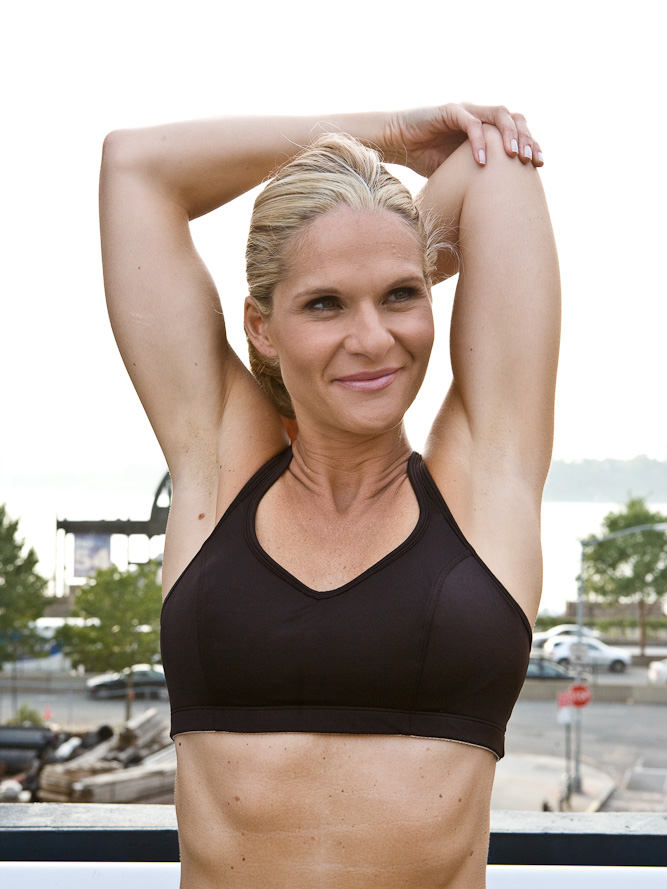
Photo by Leslie Hassler
I’ve said it before and I’ll say it again. If only I knew more about human movement science back in my 20s (and probably even in my teens), I’m pretty sure I could have avoided a whole lot of hurt in my 30s. This is why I will never shy away from writing about the importance of stretching muscles so that you can strengthen others correctly. Since my high school friend, Jennifer, took the time to write in and express her shared interest in learning more about how the various muscle groups work together, I thought I’d take this opportunity to address some other common postural distortions that can wreak havoc on your body if you don’t take the time to address them.
In my previous post about flexibility training, I discussed how sitting at my desk for long periods of time causes the tightening of my hip flexors. Unfortunately, that’s not the only part of the body that suffers because of my day job. I admit my posture can get pretty bad after typing at the keyboard for awhile. Instead of sitting up straight, I slouch or round my shoulders and stretch my neck out much more than I should. Needless to say this creates lots of tension in my neck and shoulders. (Just ask my chiropractor.)
This tension is a common problem for many office workers, and it comes from the tightening of the upper trapezius, scalenes and levator scapulae. If you bring that tension to your workout without stretching the muscles, it’s likely that when you try to perform an exercise that requires a push or a pull (e.g. a seated row or using a chest press machine) the shoulders will elevate and the head will protrude forward. This also indicates the mid/lower traps, rhomboids and rotator cuff need strengthening.
Again, while I can’t assess how you move through this blog post, I can tell you about what has worked for me in addressing this specific postural dysfunction as discovered by one of my own personal trainers in the past. This link illustrates a static stretch that helped my overactive upper traps and scalenes. I would perform one to three sets on each side, holding each stretch between 20 and 30 seconds. To strengthen my weaker muscles, my trainer had me perform the ball cobra. When it comes to strength training exercises for anyone just getting started on a fitness program, the recommendation would most likely be to one to three sets of 12-20 reps.
On any given day, our bodies are put under so many different stresses. The more we know about how flexibility and strength training work together in taking care of the muscles that move us, the better our chances of being able to stay on the right track to have fun, be fit and feel fabulous!
Where Do We Go From Here?
As we kick off another work week, I realize I’m beginning my third month of being out here in the blogosphere. So I thought this was a good time to ask you, my readers, where you’d like things to go from here.
Please feel free to send me your fitness-related questions or topics for discussion by simply leaving a comment at the end of this post. As you can tell from what I’ve written so far, I believe there are so many components to fitness that go beyond the walls of your neighborhood gym or the path of your favorite hiking trail. The choices we make ranging from what to wear when we workout to what to drink at happy hour can affect our overall well-being.
Don’t be shy! If you’re curious about something, chances are someone else is, too. Would you like more music lists or information about specific areas of exercise? As I’ve said before, while I can’t promise to have the answers immediately, I’ll be more than happy to do a little research, ask opinions of my more experienced peers in the fitness industry and let you know what I find.
I’ll close by thanking you for taking the time to read my blog and for supporting me in this adventure. If you’re a “repeat reader” and haven’t subscribed to my blog yet, perhaps you’ll do that today. (If you have, perhaps you could ask a friend to do the same!) All you have to do is click on the “Follow Blog” icon at the top right hand corner of this page and give your email address. (It’s free!) You’ll then get an email asking you to confirm you signed up and that’s it. You’ll be notified every time I post something new.
There are icons on my blog’s home page to help you follow me on Facebook and Twitter, and I also just launched a the LauraDLovesFitness channel on YouTube. Again, I thank you ahead of time for checking out my material and for spreading the word that together, we can all enjoy a lifelong journey to have fun, be fit and feel fabulous!
The Importance of Flexibility Training
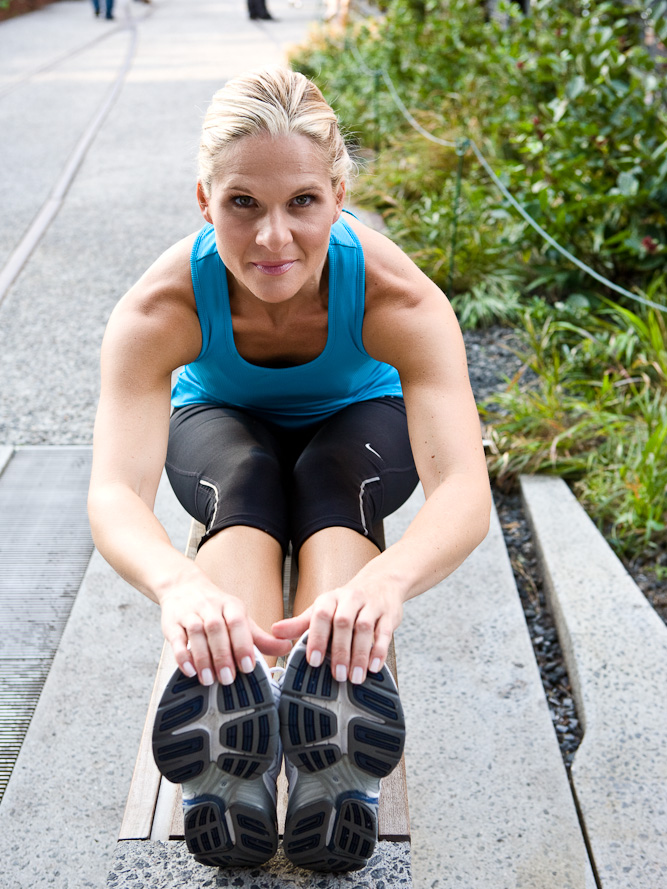
Photo by: Leslie Hassler
We made it to another Friday! If you’re like most people, you’ve clocked countless hours this week sitting at a desk crouched over a keyboard. Or maybe you’ve logged hours in your car commuting or taking the kids to and from school and activities. Regardless of your daily activities, chances are you suffer from an all-too common problem for modern day Americans: bad posture. This matched with an ever-increasing sedentary lifestyle for people everywhere make a recipe for disaster where your body is concerned. This is why incorporating flexibility training (a.k.a. stretching) is more important than ever. It is one of the best ways to decrease muscle imbalances, joint dysfunction and overuse injuries.
While I can’t assess how your body moves via this post, I can tell you about one of my biggest “problem areas.” When I’m not out in the field producing shoots, I spend way too much time sitting in front of my computer. Since I’m almost always on deadline, I tend to lose track of just how long I sit there. These extended periods of sitting unfortunately cause tightening of my hip flexors, which are made up of five muscles including the psoas.
What happens if I I don’t take the time to stretch my hip flexors and just get right into the “heart” of a workout? There are plenty of terms in exercise science to describe the problematic results, including altered reciprocal inhibition, synergistic dominance and arthrokinetic dysfunction. Here’s what those problems look like when it comes to performing one of the most popular exercises known to man: the squat. If I repeatedly perform squats with a tight psoas, the “wrong” muscles end up doing the work. The gluteus maximus should be the prime mover, but tight hips flexors inhibit the gluteus maximus from doing its job and getting strong. Instead, the workload gets picked up by the “B team:” the hamstrings and erector spinae. Not only does this make the butt-kicking exercise pretty much ineffective for actually toning my butt, but I’m also putting myself at risk for low back pain and potential injury.
Here’s a link featuring some good static stretches for the hip flexors. If you’re just getting started on an exercise program, your focus will most likely be on corrective flexibility in order to improve any muscle imbalances and altered joint motion. To that end, static stretches and self-myofascial release should be the key components in your flexibility training program. (Stay tuned for more on my own love-hate relationship with SMR in future posts!)
Another problem area for many people is the biceps femoris, which most of us know as the hamstrings. As you progress in your fitness journey, you can look forward to moving from corrective flexibility to active flexibility. In the video below, I help Brent Brookbush illustrate an effective active biceps femoris stretch. Before you check out the video, I leave you with this final thought: if I could go back in time and change one thing about my life-long love affair with fitness, I would incorporate much more flexibility training into my routine. It is truly one of the best things we can do for ourselves in order to have fun, be fit and feel fabulous!
The Importance of Balance Training
 Photo by: Leslie Hassler
Whether you’re walking down a staircase in stilettos or prepping to make a jump shot on the basketball court, balance is a key component to all functional movements. This is why balance training exercises should be a part of everyone’s fitness regimen, regardless of your fitness level.
Balance is the ability to sustain or return the body’s center of mass or line of gravity over its base of support. The National Academy of Sports Medicine (NASM) explains the purpose of balance training is to improve dynamic joint stabilization, which is the ability of the body to stabilize of keep the joints in proper alignment during movement. (One example: stabilization of the hip during a squat by the gluteus medius and adductor complex.)
Countless studies have been done which show a direct correlation between balance training and injury prevention. I think it’s safe to say we’d all agree anything that can help decrease our risk of injury is worth spending some time on.
So how do you do it? The idea is to perform exercises that constantly stress a person’s balance threshold. This is the limit a person can perform an exercise without losing control of his or her center of gravity. In “big-word terminology,” the idea is to push that threshold in a proprioceptively enriched environment. This is an environment that challenges the internal balance and stabilization mechanisms of the body.
In simple terms, balance training is typically performed on a single-leg and/or on unstable surfaces such as a half-foam roll, Airex pad or Dyna disc. For beginners, examples of balance training exercises include single-leg balance and single-leg balance reach. More “seasoned” fitness buffs may perform single-leg squats or single-leg Romanian deadlifts. Finally, balance training exercises for the experienced athlete may include multiplanar hop with stabilization or single-leg box hop-ups with stabilization.
I found this link very helpful in describing the purpose for balance training along with this one from the Mayo Clinic featuring examples of exercises. At the end of the day, balance training can be a challenging part of your exercise program and just one more way to have fun, be fit and feel fabulous!
The Importance of Core Training
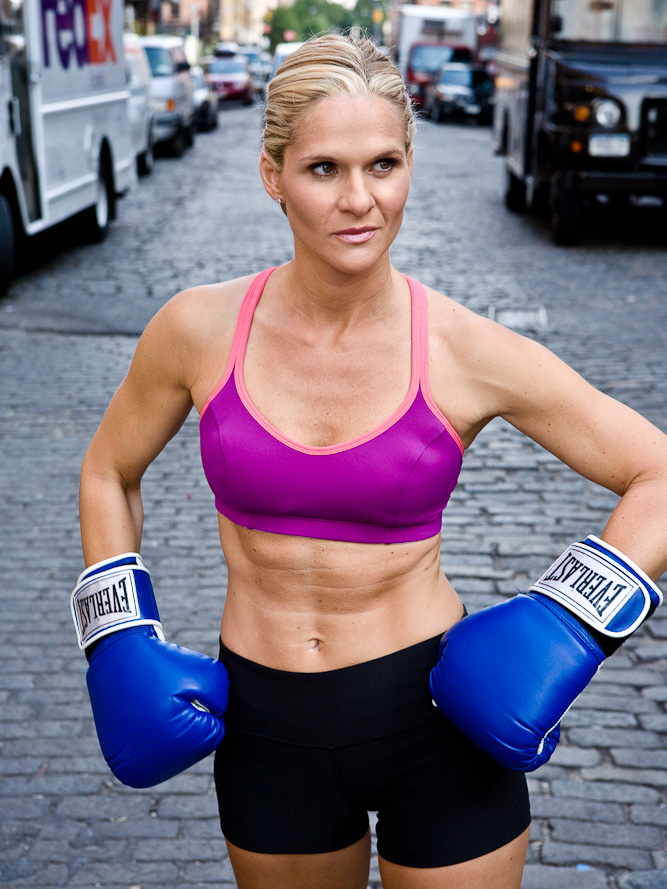 Photo by: Leslie Hassler
Chances are you’ve heard, seen or read stories about people’s quest to work on their “core.” That’s good, because core training should be a crucial component of anyone’s exercise routine, regardless of his or her fitness level. Why? To put it simply, if you have a weak and unstable core and you don’t do anything to make it stronger, your body can’t move the way it’s supposed to. That’s one of the easiest ways to put yourself at increased risk for injury.
So, what exactly is the core? It’s the part of the body made up of the lumbo-pelvic-hip-complex, thoracic spine and cervical spine. This region of the body is where all movement begins and where we find our center of gravity. The muscles in the core are broken into two categories: the stabilization system and the movement system. The important thing to keep in mind is that if the stabilization system doesn’t work properly, then your body will make compensations to move, and these compensations can ultimately lead to injury. Here’s an example: you could have strong “abs” (rectus abdominus), external obliques and erector spinae, but weak stabilizing muscles in your lumbo-pelvic-hip complex. Without proper stabilization, extra stress is placed on your vertebrae and this can lead to low back pain and possible injury.
The bottom line is you should not neglect your core. One popular exercise for core training is the quadruped. It’s a great activation exercise for the transversus abdominus, which is part of the stabilization system of the core. Below, you can check out a video where I help Brent Brookbush, President of B2C Fitness and author of “Fitness or Fiction: The Truth About Diet and Exercise,” illustrate the correct form and progression techniques for a quadruped. Brent’s videos are geared toward other fitness pros, but the information and illustration are a great way to get anyone started on this effective exercise. Remember, core training is an essential part of any exercise routine in order to have fun, be fit and feel fabulous!
Friday Favorites
At the end of a particularly crazy work week, I thought I’d wrap things up on a light note. Along with questions ranging from how to calculate heart rates to how long do I spend on my abs, people often ask me about the products I use. So, here’s a list of some of my favorite items that keep me feeling good whether I’m working out or not:
 Shower Essentials: Since I take two showers a day (one to wake up, and one to clean up after my post-work workout), I use body wash instead of soap. It keeps my skin hydrated, and that’s especially important now as the temperatures drop and the heat comes up. I’m a big fan of the St. Ives line, which can be found at any drug store. To splurge, I’ll stock up on some of my favorites at Bath & Body Works. My top picks there are in the “Stress Relief ” line. There’s something about the smell of eucalyptus while standing in a hot shower that really helps me unwind after a long day.
Must-Have Moisturizer: Since passing the 35th birthday mark a couple of years ago, I admit I’m a sucker for anything that lists “skin firming” as a benefit on the packaging. Right now, I’m using and loving Aveeno’s “Positively Ageless Skin Firming Lotion.”
Face Faves: I suffered from acne in my teens and 20s. Now in my 30s, thanks to too much sun- worshipping, I have developed Rosacea. Every dermatologist who has treated me has recommended Cetaphil and I have used it for years. I wash my face twice a day with the “Gentle Skin Cleanser” and moisturize morning and night with the “Daily Facial Moisturizer,” which contains SPF 15.
Eye Cream: L’Oreal “Revitalift Deep-Set Wrinkle Repair Eye Cream.” It’s a 24-hour “system” where you use one side of the tube in the morning to protect and the other side at night to repair.
Eye Makeup Remover: Almay “Oil-Free Eye Makeup Remover Pads.”
Mane Management: As a blonde who amps up my look with highlights, I look for products that cut down on brassiness. Right now, I am using Aveda “Blue Malva” shampoo. I admit, I mix and match shampoo and conditioners as I use whatever keeps my hair moisturized and as frizz-free as possible. Right now, there’s a tube of L’Oreal’s “Everpure Sulfate-Free Moisture Conditioner” in my shower rack.
My Must-Have Hair Product: “Hard to Get” texturizing paste from TIGI Bed Head. It adds body and makes my layers move with that tousled look.
Workout Wear: On my body: Under Armour, Nike DRI-Fit or Champion C9. On my feet: New Balance cross trainers.
In My Gym Bag: Fiber One bars; tissues; hand sanitizer, clean socks, ear buds for my iPhone and snag-free ponytail holders.
Post-Workout Mocktail: Crystal Light pink lemonade and seltzer.
If you have some products that help you feel your best everyday, I’d love to hear about them! While diet and exercise are key components to our well-being, never underestimate the power a great-smelling body wash or pampering hand cream can have to help you have fun, be fit and feel fabulous!


 lauralovesfitness