Blog Archives
Flexibility Friday
It may have been a shorter work week than usual, but I say TGIF anyway!
If you’re like most people, you’ve clocked countless hours this week sitting at a desk crouched over a keyboard. Or maybe you’ve logged hours in your car on that daily commute or took a road trip for winter break. Regardless of your daily activities, chances are you suffer from an all-too common problem for modern-day Americans: bad posture. This matched with an ever-increasing sedentary lifestyle for people everywhere make a recipe for disaster where your body is concerned. This is why incorporating flexibility training (a.k.a. stretching) is more important than ever. It is one of the best ways to decrease muscle imbalances, joint dysfunction and overuse injuries.
While I can’t assess how your body moves via this post, I can tell you about one of my biggest “problem areas.” When I’m not out in the field producing shoots, I spend way too much time sitting in front of my computer. Since I’m almost always on deadline, I tend to lose track of just how long I sit there. These extended periods of sitting unfortunately cause tightening of my hip flexors, which are made up of five muscles including the psoas.

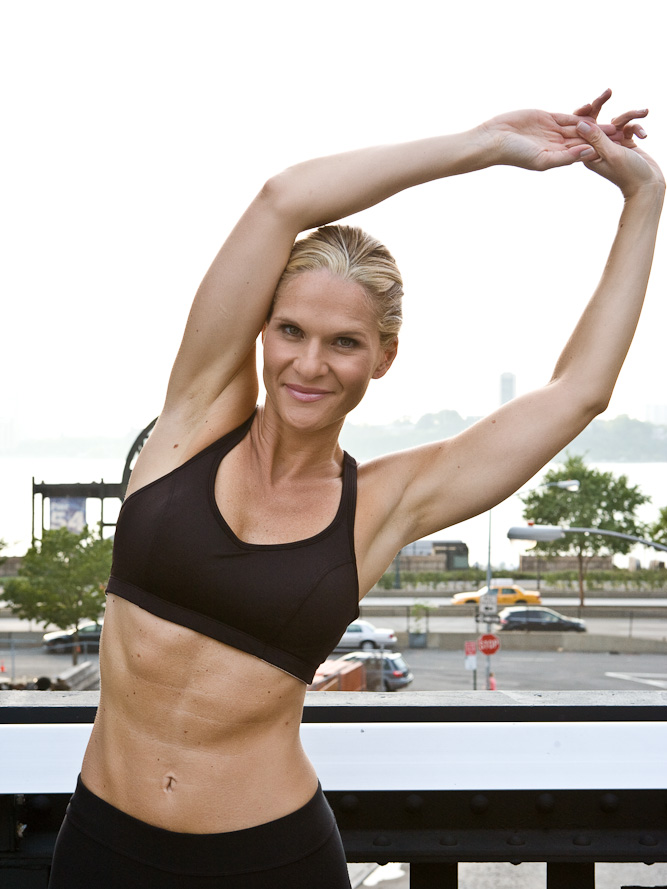
Stretch & Smile! Photo by Leslie Hassler
What happens if I I don’t take the time to stretch my hip flexors and just get right into the “heart” of a workout? There are plenty of terms in exercise science to describe the problematic results, including altered reciprocal inhibition, synergistic dominance and arthrokinetic dysfunction. Here’s what those problems look like when it comes to performing one of the most popular exercises known to man: the squat. If I repeatedly perform squats with a tight psoas, the “wrong” muscles end up doing the work. The gluteus maximus should be the prime mover, but tight hips flexors inhibit the gluteus maximus from doing its job and getting strong. Instead, the workload gets picked up by the “B team:” the hamstrings and erector spinae. Not only does this make the butt-kicking exercise pretty much ineffective for actually toning my butt, but I’m also putting myself at risk for low back pain and potential injury.
Here’s a link featuring some good static stretches for the hip flexors. If you’re just getting started on an exercise program, your focus will most likely be on corrective flexibility in order to improve any muscle imbalances and altered joint motion. To that end, static stretches and self-myofascial release should be the key components in your flexibility training program.
I’ve said it before, and I’ll say it again: if I could go back in time and change one thing about my life-long love affair with fitness, it would be to incorporate much more flexibility training into my routine. It is truly one of the best things we can do for ourselves in order to have fun, be fit and feel fabulous!
Give Yourself a Break

Stop and Take a Breath! Photo by Leslie Hassler
Wow! I can honestly say this is one week that couldn’t come to an end soon enough.
Between work and happenings outside of work, I felt like I simply couldn’t catch my breath. One thing in particular that got to me was the fact that for the first time since I started this blog, I wasn’t able to write a new post for Wednesday. Life got in the way, and I was actually angry with myself for not getting it done. Then halfway through that busy workday, I stopped and remembered a famous quote from John Lennon: “Life is what happens to you when you’re busy making other plans.” Then I took a deep breath and got over it.
It amazes me how hard we can be on ourselves. We make never-ending to-do lists and get flustered when we can’t cross off the 30th item in a 24-hour period. When the fun things become chores, that’s when it’s time to step back and realize you may not be able to get everything done at the exact moment you want. And really, unless someone’s life is at stake, it’s not the end of the world.
For me, that means my love affair with exercise sometimes has to take a backseat to other things, like much-needed sleep. Yesterday, I set the alarm for 5:30 am hoping to get my heart pumping before a day at the office followed by a personal training session. There was no way I could workout afterward at a late hour, especially on an empty stomach! However, when the alarm went off, my body practically screamed at me to stay in bed. So I did. I’m convinced that extra snooze time helped me write coherent scripts and meet my production deadlines at the office and be a more focused trainer for Lauren at the gym afterward.
This week didn’t go as planned on many levels. So, I did the best I could to face the unexpected challenges with the energy I had to face them. All that means is during the weekend ahead, I’ll make a new list with a new plan for more workouts, more blog posts and hopefully, some more sleep. The reality is taking a deep breath and “forgiving” yourself for what you couldn’t get done can sometimes help you climb what feels like an uphill battle to have fun, be fit and feel fabulous!
Here’s to Another Workout Wednesday!
Happy Workout Wednesday!

Photo by Leslie Hassler
This week I offer some new exercises for your stabilization endurance routine. There’s something important to note about this level of training: it’s not just for workout newbies and those returning to exercise after a hiatus.
NASM teaches it’s also crucial for exercise veterans to re-visit the stabilization level after periods of strength or power training. Why? Because performing exercises that challenge the body’s proprioception is a surefire way to maintain your core and joint stability. I don’t care how much weight you can push with your chest muscles on a bench or curl at a seated machine with your biceps. After intense strength or power training, keeping your body in a bridge while performing a couple of sets of ball dumbbell chest presses offers a good reminder of how important it is to maintain your core strength!
Don’t forget to warm-up before jumping into this routine and cool-down when you’re done. For each exercise, aim for two sets of 12-15 reps.
Core:
Resistance:
- Total body: Step up balance to overhead press
- Chest: Push ups
- Back: Ball cobra (2-arm)
- Shoulders: Single-leg dumbbell scaption (alternating arm)
- Biceps: Single-leg bicep curl
- Triceps: Supine ball dumbbell triceps extension
- Legs: Body weight squats
I don’t mean to sound like a broken record, but you need to visit and re-visit this training level throughout your year-round workout cycle to keep your muscles the way they’re supposed to. If you’re a “regular” here at LauraLovesFitness.com, you may know the following chain reaction by heart: when your muscles don’t work properly, your body makes compensations to keep moving. Those compensations eventually lead to muscle imbalances which lead to increased stress on the joints which can ultimately lead to injury.
As with the other workouts I’ve presented, your goal should to perform today’s program two to three days each week, but don’t perform the same routine on back-to-back days. Your muscles need time to recover and repair, which is accomplished through rest. So you could perform this program on Tuesdays and Thursdays and get your cardio on the in-between days. Whatever you do, never skimp on the stretching!
So, what are some of your favorite stabilization exercises? You know I’m always looking for new ideas to help all of us on our quest to have fun, be fit and feel fabulous!
Workout Wednesday: Another Stabilization Endurance Routine

Stabilization Before Strength! Photo by Leslie Hassler
Happy Workout Wednesday!
As I received some positive feedback on the total-body workout I posted last week, I thought I’d post another one. Just like last Wednesday’s plan, these exercises provide a total-body resistance training workout for what NASM calls the stabilization endurance phase of training. If you’re new to the gym or returning after a break, this is the type of plan you should follow.
Don’t forget to warm-up before jumping into this routine and cool-down when you’re done. For each exercise, aim for two sets of 12 reps. (If you’ve never worked out before or starting again after a very long break, one set is just fine.)
Core:
- Single leg balance reach (**2 sets of 8 reps for each leg**)
- Total body: Ball squat to curl to overhead press
- Chest: Ball dumbbell chest press
- Back: Ball dumbbell row (2-arm)
- Shoulders: Ball military press
- Biceps: Single-leg bicep curl
- Triceps: Prone ball dumbbell triceps extensions
- Legs: Step-up to balance
I cannot stress enough the importance of the stabilization training phase being the correct starting point for an exercise regimen. Without stabilization, your muscles don’t work the way they’re supposed to and your body will make compensations to keep you moving. Those compensations lead to muscle imbalances which lead to increased stress on the joints which in the end can eventually lead to injury.
Aim to perform this program two to three days each week, but remember not to perform the same routine on back-to-back days. Your muscles need time to recover and repair, which is accomplished through rest. So perhaps you perform this program on Mondays and Wednesdays and get your cardio in on the in-between days. Whatever you do, make sure you don’t skimp on the stretching! I will be eager to hear more feedback on whether or not this program helps you on your journey to have fun, be fit and feel fabulous!
Don’t Forget to Rest!
Don't Forget to Rest! Photo by Leslie Hassler
It seems like yesterday I was looking forward to wrapping up 2011 with some down time and here we are cranking away at the near mid-month mark of January 2012! For those of you who’ve kicked your fitness resolutions in the butt by pounding the pavement or hitting the gym every single day since the New Year started, let me first be the first to offer a big, congratulatory pat on the back. Now I want you to take a day off!
You might be saying, “but Laura, you’re on Twitter, you know it’s #Workout Wednesday!” I didn’t say you have to make today your off-day, but you do need a minimum of one rest day during the week.
A rest day allows the body to recover from the stress of exercise and presents an opportunity for muscular repair and recovery of the central nervous system. Pushing your body day after day at the same group exercise class or on the same weight training circuit or along the same 5-mile route is one of the quickest paths to burning out on your routine. This can be especially true for anyone who’s new to a workout routine or just coming back after a lengthy hiatus.
The possibility of a mental meltdown aside, continuously pushing the body to the limit puts you at risk for overtraining. The following are some of the symptoms to look out for to determine if you’re overdoing it:
- Fatigue
- Increased resting heart rate
- Increased resting blood pressure
- Slower recovery after exercise
- Overuse or stress-related injuries (e.g. stress fractures, tennis elbow and runner’s knee)
- Insomnia
- Irritability or moodiness
- Disinterest in sex
- Amenorrhea (when a woman stops getting her monthly period)
- Increased numbers of colds / sore throats (shows decreased immunity)
- Decreased appetite
From what I learned through my NASM and AFAA studies, a good training frequency for the fitness newbie or anyone returning after a hiatus is three resistance workouts each week. This allows you to work your muscle groups with 48 hours of recovery in between. Cardio can be done on the in-between days or even on the same day. Even more seasoned athletes should give a muscle group a 48-hour rest period before pushing it to the limit again. Another good rule of thumb is to mix up your routine with cross training. Although I’m excited to take as many Zumba® classes as possible to continue my teaching prep, I’ll be sure to spread the classes out throughout the week. The same should be applied to your favorite cardio kickbox class or your favorite at-home DVD workout.
For those of you who can’t fathom even one day without any activity, turn your run into a long, leisurely walk or substitute your favorite cardio class with an extra-long session of stretching. In fact, the good news about flexibility training is that it can be done every single day of the week!
The bottom line is to remember taking a rest day doesn’t mean you’re being lazy. Rest is an important component of any fitness routine because it gives your body the energy to have fun, be fit and feel fabulous!
Make Your Fitness Resolutions Stick!
Happy New Year, everyone! I hope you enjoyed the holidays and some good times filled with family, friends and good food.

Kick Your Resolutions in the Butt! Photo by Leslie Hassler
If you’re like a lot of people, you’ve made your list of New Year’s resolutions and there’s a good chance something related to health and fitness take up the top spots. I love seeing so many new faces at the gym at this time of year, but I hate the fact that usually by March, many of those enthusiastic newbies are long gone. So, I kick off 2012 with a few tips that I hope will help anyone who has decided THIS is the year they’re finally going to make those fitness resolutions stick long after Old Man Winter has made room for Spring.
- Leave the Past Behind. Don’t waste your energy regretting the times you overdid it during the holidays. I have my own memories of indulging in a second piece of lasagna and/or chocolate cake. Today is a new day.
- Adjust Your Attitude. Think of exercise as a “chore,” and no doubt you’ll be done with your new routine in no time. Instead, think of exercise as “Me Time.” No matter what’s going on in my life, the time I spend working out is the one time my brain goes into neutral and the only thing filling it is my music. So, use exercise as a break from the ordinary, and before you know it, you’ll be looking forward to sweating out whatever ails you.
- Be Realistic. Saying you’re going to exercise seven days a week is one of the easiest ways to set yourself up for failure. The first day you miss, you’ll be discouraged, and could find yourself saying, “Well, I just blew the whole week!” A more realistic approach would be to aim for a minimum of three days each week for the first month. As you start experiencing the endorphin-rush and other benefits from exercising, you’ll want to spend more than three days working out. Discouragement aside, everyone should take a minimum of one day off each week to let the body rest.
- Find What Works for You. You woke up Christmas morning to find Santa left the latest version of P90X under your tree. Meanwhile, all your exercise DVDs have been hanging with the dust bunnies under your bed since VHS went out of style. Why not return the new program and put the money toward a new pair of sneakers and moisture-wicking workout wear? Grab a friend and start those power walks or sign up for that Hip-Hop or Zumba class at your local community center. Have no idea what to try? Splurge and hire a personal trainer to get you started on the right track or get a book that breaks things down for you in simple English.
- Avoid Extreme Food Restrictions. If you deny yourself something you truly enjoy for too long, it’s only a matter of time before you break down and go overboard. So, the chocolate bar you could have had last week turns into five chocolate bars, washed down with a chocolate shake and a side of cupcakes two months later.
I leave you with this reality: there will be “off” days. Even as a lifelong fitness enthusiast, there are times I simply don’t want to workout and all I want to eat is cheese and chocolate. It happens. Just don’t let one bad day throw you off course. Just wipe away the crumbs, prep your gym bag and remember tomorrow is your next chance to have fun, be fit and feel fabulous!
Fitness for the Mind: Holiday Edition

Chill Out! Photo by Leslie Hassler
One of my first posts here on LauraLovesFitness was all about the importance of keeping your brain in shape along with your body. With the holiday season in full swing, I thought it was the perfect time to remind everyone about the importance of keeping your mind healthy during the hustle and bustle of this joyous but frenetic time of year.
No doubt exercise can help you shake off some of the extra calories and some of the extra stresses associated with this season, including crowded stores, travel delays and spending extended amounts of time with the extended family. However, when you factor in how online shopping and maybe some lo-cal recipe surfing are added to the year-round attack on our senses – emailing, texting, Tweeting, updating our Facebook status and even DVR-ing – it’s no wonder our minds are in overdrive. With so much more than sugar plums dancing through our heads, it could be more important than ever to challenge yourself to steal some precious moments to simply disconnect and re-boot. Here a few tips to make it happen:
- Focus on one thing at a time: If you know you’re setting aside an hour to wrap gifts, then for that hour, don’t deal with texting or answering emails. If it makes you feel better, you can alert your social network that you’ll be offline for a bit. Then put on the holiday tunes (or whatever motivates you to be a good elf) and get to work.
- Step away from the computer: This month, I have been making a very conscious effort to NOT turn on my home computer unless absolutely necessary when I get home from work and the gym. I still check my iPhone at least once before bed to make sure I didn’t miss any “emergency” emails, but it makes a difference not to have the laptop on with the Facebook tab taunting me to make my way back to the keyboard.
- Turn off the TV: We still have a no-TV “rule” in our home on Wednesdays. I’m really looking forward to it this week, as it will be nice to decompress with a game of Backgammon or cards. It may turn into a night of getting the Christmas gifts in order, but it’ll be time to tackle those holiday chores with fewer distractions.
- Steal some time for YOU: If you’re making the commitment to find 20-30 minutes in your crazy schedule for a workout, take another 5 minutes to stretch. Then maybe add a few more minutes to a hot shower at night. Treat yourself to a lavender-scented body wash or moisturizer to turn that shower in to an extra calming experience for your senses. Sip some caffeine-free tea afterward and try to shut down that overactive mind before getting under the covers.
As we work through this holiday high-time and you make an effort to workout, don’t forget the importance of standing still for awhile, too. Never underestimate the power of your mind on the journey to have fun, be fit and feel fabulous!
More Core

Photo by Leslie Hassler
Thanks to an inquiry from Erin, a friend from my “old” life as a TV reporter, I kick off month five of LauraLovesFitness.com by re-addressing one topic that is crucial to an effective and safe exercise program: core training.
Erin is getting back into her exercise groove and hopes strengthening her core will help alleviate some of the lower back pain she experiences doing everyday things like carrying her little ones around. As you other busy moms can relate to, she doesn’t have tons of time to dedicate to core training so she’s looking for no-nonsense core exercises.
Before I offer my three favorite exercises, here are a couple of important reminders:
- If you have severe lower back pain, make sure you get to a doctor and rule out any serious injury before starting core training or any type of exercise program.
- In case you forgot why core training is so important for women and men of all ages: the core is the region of the body where all movement begins and where we find our center of gravity. So, in the simplest terms, if you have a weak or unstable core, your body can’t move the way it’s supposed to. That’s one of the easiest ways to put yourself at increased risk for injury.
Now that I’ve gotten that off my chest, I present my core favorites:
- The Bridge – strengthens the glutes and stabilizes the lower back muscles.
- The Plank – makes all your core muscles work to keep your spine in line.
- The Crunch – works those abs!
If you’re like Erin and getting started on a program, attack the first week with one to two sets of each of the above-mentioned exercises, aiming for 12 to 20 reps. Before you start any of the exercises, make sure to draw your belly-button in toward your spine and continue to do throughout the duration of the exercises. Don’t rush through the reps to get a high number done. It’s better to perform 12 reps in perfect form than 15 sloppy ones. Perform the entire core circuit (all three exercises) on two to three non-consecutive days during the week. In week two and beyond, continue to add reps until you can do three sets of 25 reps.
What’s great about these exercises is that you can do them anywhere. As you progress in your routine and want to add an extra challenge, a stability ball may be just what you need. When you do get to the point when 25 reps get too easy (and you WILL get there!), here’s a link I like from SHAPE magazine that can help take you to the next level.
Confused About Muscle Confusion?

Photo by Leslie Hassler
I kick off this new work week addressing a great question from Ally. She asked about “muscle confusion,” a key concept in the workouts you see all over TV that promise to get you “ripped” in 90 days without going to the gym.
First, I have to admit due to space limitations in all the apartments I’ve lived in since getting out of college, I’ve always worked out at the gym. So, I’ve never bought or used any of these 90-day surpreme workout programs. However, I do know many people who use them and love them.
Second, from an exercise science perspective, muscles can’t technically get “confused.” What they can do is grow stronger through a process called volume overload. Another phrase you often hear when people describe their fitness goals is a desire to “tone up.” Again, this is technically an incorrect statement as sticking with an exercise program won’t “tone” muscle, but it can help you improve your overall muscle definition. Basically, whether you’re working out at the gym or in front of the TV, if you increase the workload placed on your body, you burn more calories than you store, which leads to a loss in body fat and an improvement in muscular definiton.
Ally also asked me how often I change my resistance training routine. What I learned through the National Academy of Sports Medicine is that whatever phase of training you’re in, you should stick with a current routine for a minimum of four weeks before moving on to the next level. This gives your body time to adapt to the stimuli you’re placing on it. That doesn’t just mean changing the exercises you’re doing, but adding to the workload you’re demanding your body to perform. When it comes to resistance training, that workload increase comes in the form of reps x sets x weight.
Remember, change doesn’t have to be drastic. It can simply involve cutting back on the amount of rest between exercises to push caloric burn to the max. Change can also involve filling your schedule with group boxing class on Monday, group body conditioning on Wednesday and a solo weight machine circuit on Friday. Want another reason to mix up your routine? It’s simple: too much of a good thing is never good. Doing the same exercises every day is a surefire way to increase your risk of overuse injuries. Which brings me to another important reminder: your body needs adequate rest to make adequate gains. So, be sure not to work the same muscle groups on consecutive days.
I want to wrap up with what could be most important: in a world filled with instant everything, you need to be patient when it comes to reaching your diet and exercise goals. Anything done in an extreme fashion may produce fast results, but these results are often unsustainable. Drastically restricting your calorie intake and working out for 90 minutes, seven days a week may get you into that dress for the reunion. Chances are once you go back to your normal lifestyle, the weight will come back and any gains you made will be lost.
In the end, the choice is yours. Whether you try a 90-day DVD exercise program, join a gym or start taking tennis lessons with a friend, the key is to find what works for you so that you stick with it and don’t stray from the path to have fun, be fit and feel fabulous!
Getting “Back” to Flexibiity
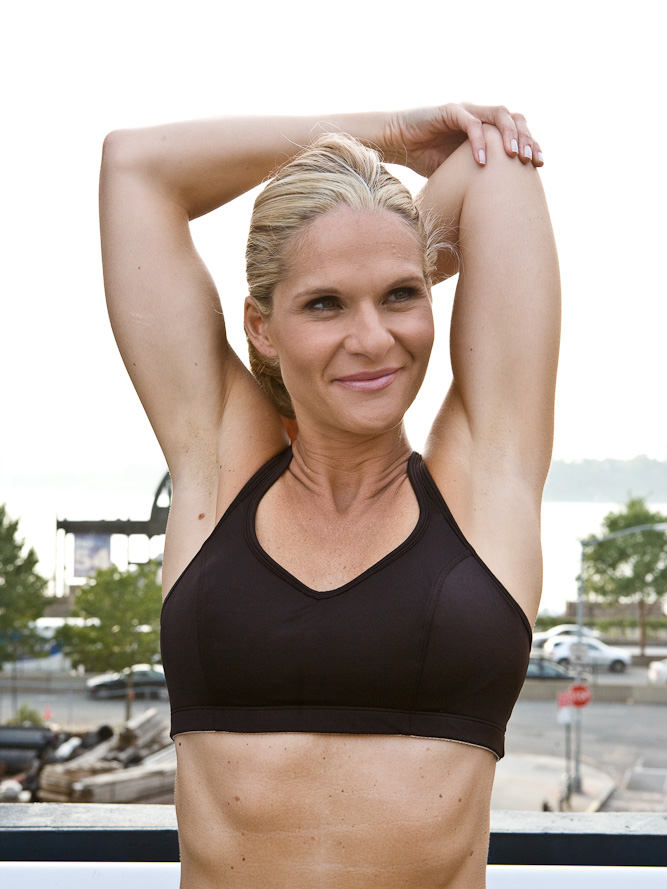
Photo by Leslie Hassler
I’ve said it before and I’ll say it again. If only I knew more about human movement science back in my 20s (and probably even in my teens), I’m pretty sure I could have avoided a whole lot of hurt in my 30s. This is why I will never shy away from writing about the importance of stretching muscles so that you can strengthen others correctly. Since my high school friend, Jennifer, took the time to write in and express her shared interest in learning more about how the various muscle groups work together, I thought I’d take this opportunity to address some other common postural distortions that can wreak havoc on your body if you don’t take the time to address them.
In my previous post about flexibility training, I discussed how sitting at my desk for long periods of time causes the tightening of my hip flexors. Unfortunately, that’s not the only part of the body that suffers because of my day job. I admit my posture can get pretty bad after typing at the keyboard for awhile. Instead of sitting up straight, I slouch or round my shoulders and stretch my neck out much more than I should. Needless to say this creates lots of tension in my neck and shoulders. (Just ask my chiropractor.)
This tension is a common problem for many office workers, and it comes from the tightening of the upper trapezius, scalenes and levator scapulae. If you bring that tension to your workout without stretching the muscles, it’s likely that when you try to perform an exercise that requires a push or a pull (e.g. a seated row or using a chest press machine) the shoulders will elevate and the head will protrude forward. This also indicates the mid/lower traps, rhomboids and rotator cuff need strengthening.
Again, while I can’t assess how you move through this blog post, I can tell you about what has worked for me in addressing this specific postural dysfunction as discovered by one of my own personal trainers in the past. This link illustrates a static stretch that helped my overactive upper traps and scalenes. I would perform one to three sets on each side, holding each stretch between 20 and 30 seconds. To strengthen my weaker muscles, my trainer had me perform the ball cobra. When it comes to strength training exercises for anyone just getting started on a fitness program, the recommendation would most likely be to one to three sets of 12-20 reps.
On any given day, our bodies are put under so many different stresses. The more we know about how flexibility and strength training work together in taking care of the muscles that move us, the better our chances of being able to stay on the right track to have fun, be fit and feel fabulous!


 lauralovesfitness